
How Fast You Have to Call a Lead Back Before It Goes Cold
You have about five minutes before your odds of reaching a new lead start collapsing, and about an hour before most companies have already lost the job to whoever called back first. That window is shorter than almost every home-service business thinks it is.
TL;DR
Lead response time is the gap between when someone contacts your business and when your team actually responds, not when you notice the message.
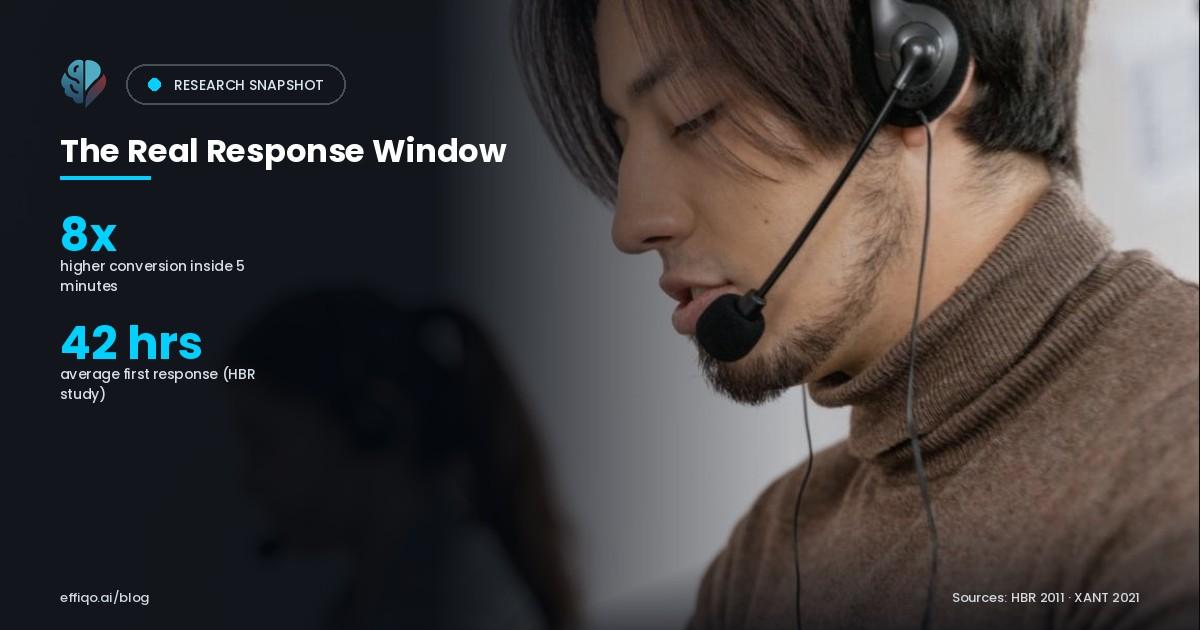
A Harvard Business Review study of 2,241 companies found the average first response to a web lead took 42 hours, and 23% never got a response at all.
A separate report covering 14,000 companies and 55 million sales interactions found leads contacted within the first 5 minutes converted 8x more often than leads reached later.
Most home-service businesses aren't losing jobs to bad marketing. They're losing them in the gap between "someone called" and "someone called them back."
What Is Lead Response Time, and Why Does It Matter So Much?
Lead response time is how long it takes your business to make real contact with someone after they reach out: a phone call, a missed call, a text, a web form, or a chat message. It starts the moment they act, not the moment your team sees it.
For a home-service business, that clock is brutal. A homeowner with no heat at 7 PM is not leaving a polite voicemail and waiting for a callback tomorrow. She's calling the next company on Google while yours is still ringing. A slow leak under the sink, a tripped breaker, a roof that started leaking mid-storm: none of these are problems people sit on. They're problems people solve with whoever picks up first.
That's the part that's easy to miss from inside the business. Missed calls don't show up as cancellations on the schedule. They just disappear. The lead never becomes a job, so nobody ever sees what it cost.
How Fast Do You Actually Have to Respond?
There's real research behind this, not just industry folklore.
A Harvard Business Review study by James Oldroyd, Kristina McElheran, and David Elkington audited web-lead responses across 2,241 U.S. companies. The average first response took 42 hours. Only 37% of companies responded within the first hour, and 23% never responded to the lead at all. As the authors put it plainly: most companies are not responding nearly fast enough.
A more recent lead response report analyzing 14,000 companies and 55 million sales interactions found that leads contacted within the first five minutes converted 8 times more often than leads reached later, and that 57.1% of leads waited more than a week before anyone made contact.
Neither study is about home services specifically. But the pattern holds everywhere response time has been measured: the value of a lead doesn't decline gradually. It falls off a cliff, and the cliff is close to the beginning.
What Happens Minute by Minute While a Lead Waits?
Picture a homeowner whose water heater just failed. She doesn't call one company and wait. She calls two or three, then books with whichever one actually talks to her, gives her a real answer, and gets her on the schedule.
In the first five minutes, you're often the only company she's spoken to. By the time an hour has passed, she has probably talked to a competitor, gotten a straight answer, and booked the job, while your callback is still sitting in a voicemail queue. This is why the 8x conversion gap from the report above tracks with what dispatchers already know instinctively: the first real conversation usually wins, not the best-priced estimate that shows up a day later.
Why Can't Most Home-Service Teams Hit the Window Consistently?
Not because anyone is careless. Because the job of "answer instantly, every time" doesn't fit inside how a front office actually runs.
Your office team is answering the phone, but also processing payments, handling a warranty call, coordinating a reschedule, and talking to a technician who needs a part number. A call that comes in during a busy stretch rolls to voicemail, not from neglect, but because a human being can only do one thing at a time. After hours, the gap is total: nobody is there at all unless you're paying for overnight coverage. During a seasonal surge (the first heat wave, the first freeze, storm season for roofing), call volume spikes exactly when your team has the least slack to absorb it.
Response time isn't a discipline problem. It's a capacity problem. Asking your office to hit a five-minute window on every call, every hour, every day, is asking people to do a system's job.
What About Nights, Weekends, and Your Busiest Season?
This is where the gap is widest. Most home-service businesses have some plan for daytime coverage and no real plan for the rest of the clock. Nights, weekends, and the seasonal peaks that generate the most urgent calls are exactly when response time tends to collapse to zero, because there's simply no one available to answer.
A voicemail greeting is not a response. A callback the next business morning is not a five-minute window. It's closer to the 42-hour average that HBR's research flagged as the industry norm. If your after-hours plan is "we'll call them back when the office opens," you're not competing for that lead. You've already lost it to whoever answered at 9 PM.
How Do You Build a System That Actually Holds the Window?
Consistently hitting a five-minute response, at any hour, on every channel, isn't something you get by asking your team to try harder. It requires something that answers immediately by default: every call, every text, every after-hours inquiry, and only brings in a human when the situation actually calls for judgment.
That means: instant pickup regardless of time of day, enough context to ask the right qualifying questions on the first contact, and a direct path to booking rather than a promise to follow up later. Anything short of that reintroduces the same gap, just in a different shape.
Where Effiqo Fits
This is the specific problem Effiqo's revenue infrastructure is built to close. Elise answers every inbound call and message the moment it comes in (nights, weekends, and mid-surge), asks the questions a real coordinator would ask, and books the job directly onto your calendar instead of leaving a message for someone to return later. The five-minute window stops depending on who's available in the office, because it's never unattended in the first place.
That's the inbound half of the picture. The other half is what already went cold in your CRM before you read this: old leads and stalled estimates. That's Xavier's job, working dormant leads back into the pipeline on a schedule instead of leaving them to expire silently. Together they're the revenue infrastructure layer that keeps response time from depending on who happens to be free when the phone rings.
FAQ
What counts as a "lead" for response-time purposes?
Any inbound contact where someone is asking your business for help: a phone call, a missed call, a text message, a web form submission, or a chat inquiry. The clock starts the moment they reach out, regardless of channel.
Does lead response time only apply to web forms, or phone calls too?
It applies to every channel, but phone calls matter most in home services, since most urgent requests still come in by phone. A missed call is a lead response failure just as much as an unanswered form.
What's a realistic lead response time benchmark for a home-service business?
Under five minutes is the standard the research above points to for maximizing conversion. Under an hour is the minimum bar; the HBR data shows most companies don't even clear that.
Can a small team realistically hit a five-minute response window on their own?
During business hours, sometimes. Nights, weekends, and peak season are where an unstaffed front office makes a five-minute window nearly impossible without automated coverage.
How does Effiqo help with lead response time?
Elise answers inbound calls and messages immediately, at any hour, and books the job on the spot instead of routing it to a callback queue. Xavier handles the leads that already went cold, reactivating them from your CRM.
Ready to see how fast your leads could actually be answered? Book a Demo.


