
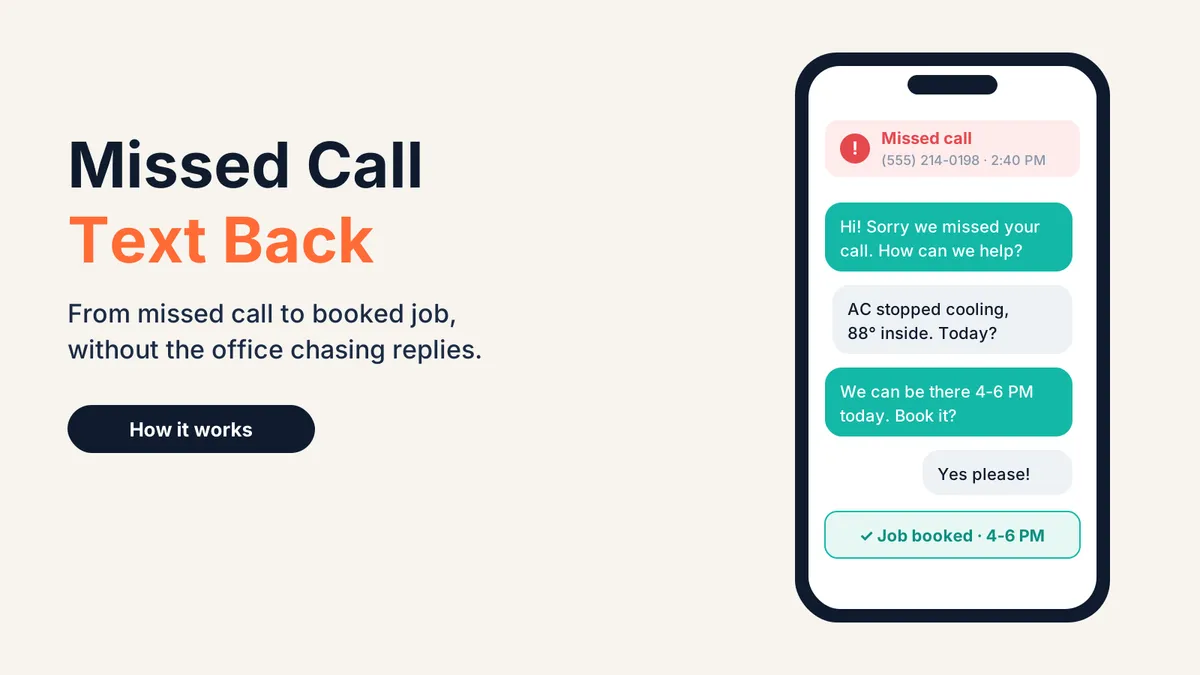
Missed Call Text Back: How It Works and Why It Books More Jobs
It's 2:40 on a Tuesday afternoon. Three of your techs are on jobs, your office manager is on the phone with a supplier, and the main line rings. Nobody picks up. The caller doesn't leave a voicemail. They go back to Google and call the next contractor on the list.
That one missed call could have been a $9,000 system replacement. Home service businesses lose calls like this every day, and it's rarely because nobody cares. Usually everyone is busy doing the work. Missed call text back was built for this moment. It isn't a complete answer, though, and knowing where it falls short matters as much as knowing how it works.
What Is Missed Call Text Back?
Missed call text back is an automation that sends a text message to a caller as soon as their call goes unanswered. Instead of the lead going quiet, the caller gets a message within seconds saying you got their call and asking how you can help.
Its job in your lead response process is simple: it keeps the conversation alive. A caller who gets a text back is far less likely to move on to a competitor, because they already have a thread open with you. For a business that can't staff the phones every minute of the day, that matters a lot.
How the Missed Call Text Back Flow Works
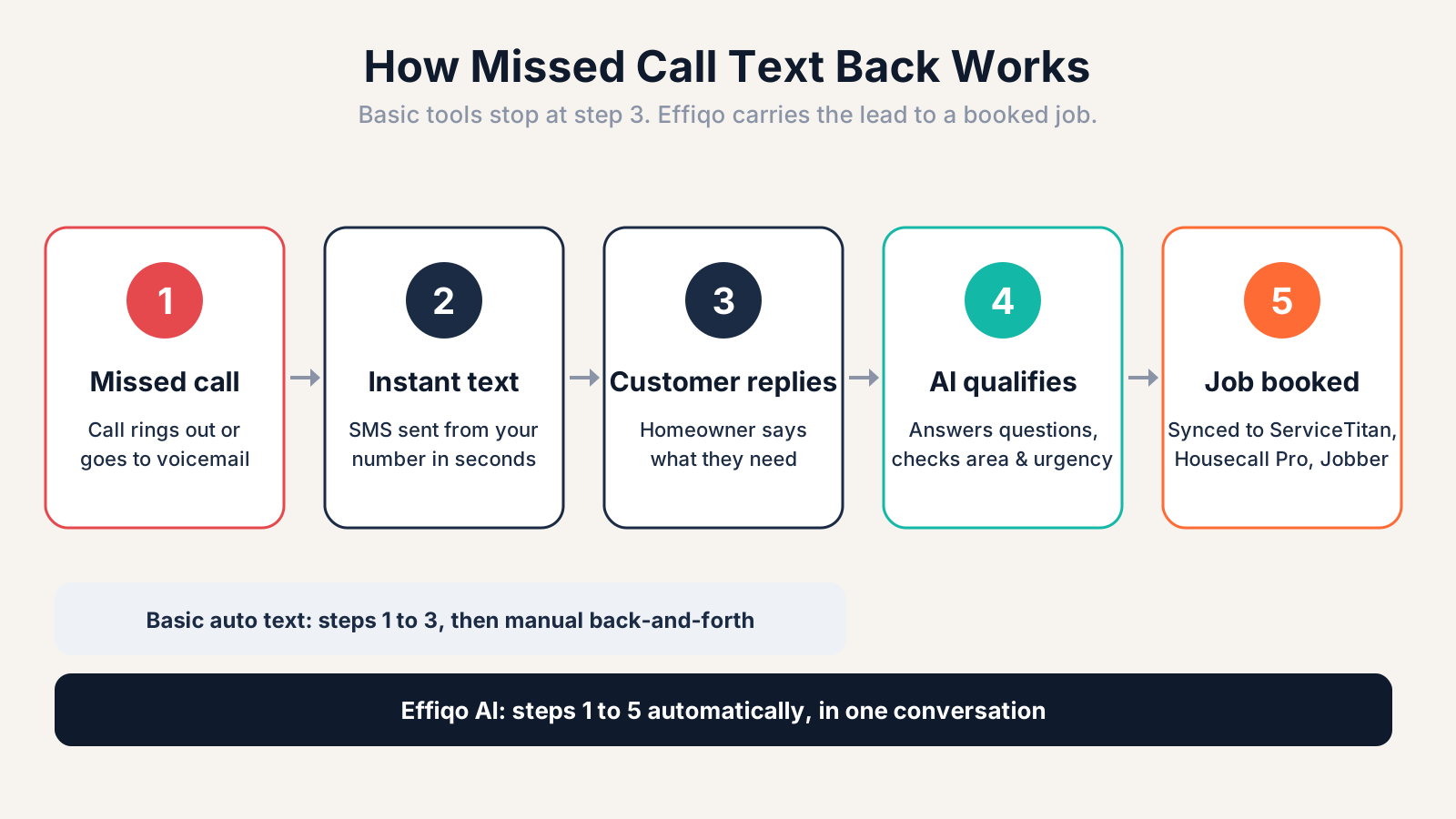
Most systems follow the same four steps:
The missed call is detected. Your phone system or call tracking platform sees that a call rang out, went to voicemail, or was abandoned.
An instant text goes out. Within seconds, the caller gets an SMS from your business number. A typical message reads: "Hi, this is Summit Heating & Air. Sorry we missed your call! How can we help you today?"
The customer replies. The homeowner texts back with what they need, such as "AC is blowing warm air" or "Need a quote on a new water heater."
Follow-up happens. Someone, or something, picks up the conversation, answers questions, and works toward a booked appointment.
Steps one through three are fully automated in almost every tool. Step four is where results start to differ.
Why Missed Call Text Back Books More Jobs
The case for missed call text back rests on two facts: contractors miss many calls, and leads go cold fast.
On the first point, Service Direct's 2019 Home Service Call Performance report, which analyzed calls across 42 home service categories, found that only 66% of calls were answered on average. That leaves about a third of inbound demand at risk before anyone has spoken to the customer.
On the second point, response timing has a measurable effect on outcomes. The Lead Response Management Study, run by Dr. James Oldroyd with InsideSales.com, analyzed more than 15,000 web-generated leads and over 100,000 call attempts. It found that reaching out within five minutes instead of 30 was associated with 100 times higher odds of making contact and 21 times higher odds of qualification. A text that goes out within seconds puts you inside that window even when nobody can pick up.
Text also suits the homeowner's situation. Someone standing in a flooded utility room or a hot living room doesn't want to call five companies and sit through hold music. A text arriving in their pocket is easy to answer, and it tells them a real business noticed. You stay in the running when a competitor who let the call go to voicemail is already out.
Where a Simple Auto Text Falls Short
Contractors who have used basic missed call text back tools tend to describe the same problem: the text works, and then the office drowns.
Here's what it usually looks like. The homeowner gets "Sorry we missed you, how can we help?" and replies right away: "AC stopped cooling, it's 88 inside and climbing. Can someone come today?"
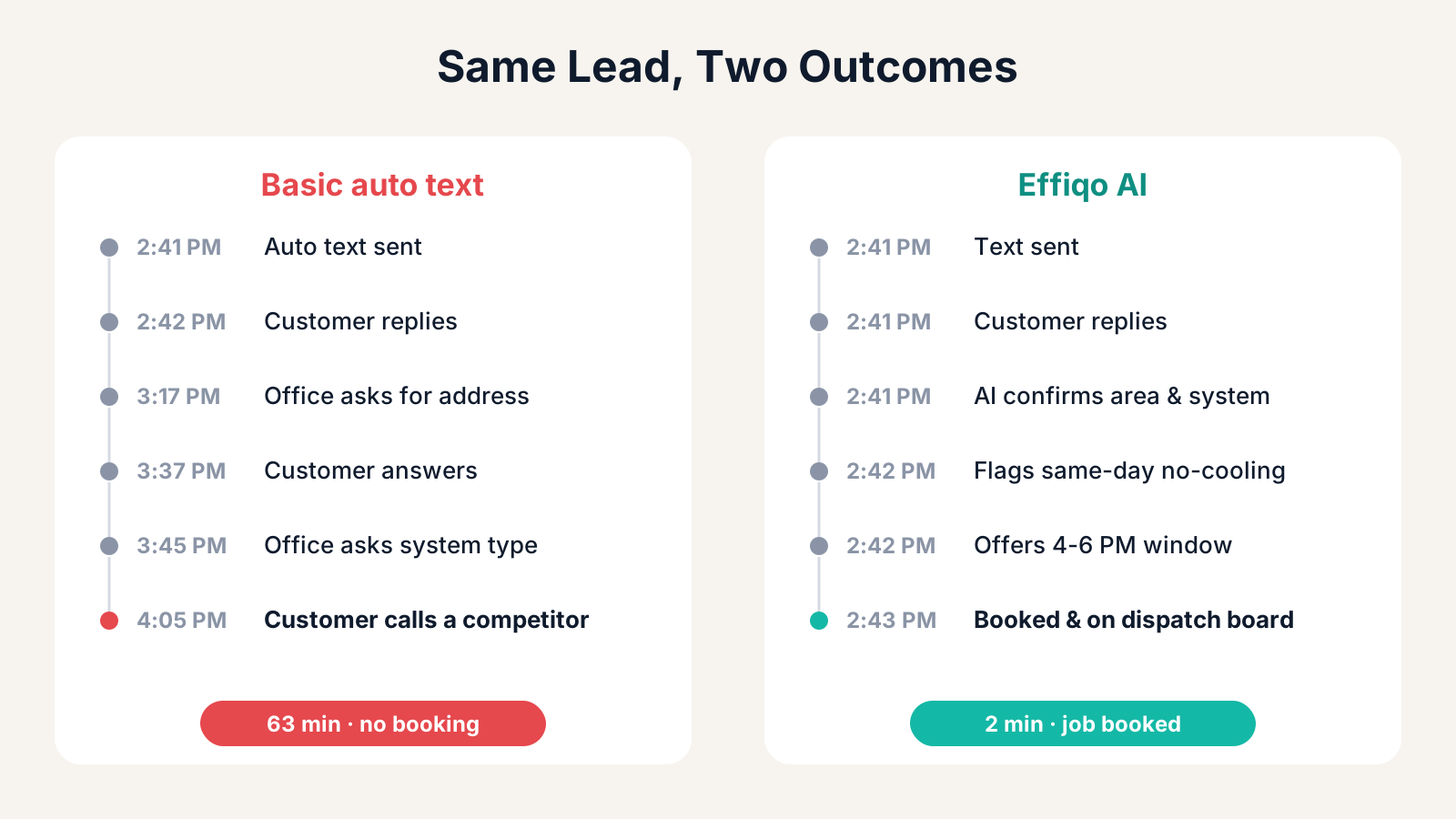
Then nothing happens. The reply sits in a shared inbox until your office manager finishes her current call, sees it 35 minutes later, and writes back asking for the address. The homeowner answers 20 minutes after that. She asks whether it's a central system or a mini split, whether they're a maintenance plan member, and what times work. Each answer takes another few minutes. Six messages in, there's still no appointment, and the homeowner has started calling other companies to hedge their bet.
The auto text didn't fix the bottleneck. It moved the bottleneck from the phone to the inbox. Specifically, basic automation leaves four gaps:
Unanswered questions. "Do you service my area?" "What's your diagnostic fee?" "Do you work on Trane units?" A static template can't answer any of these.
Qualification. Is this an emergency or routine work? A repair or a replacement opportunity? Is the caller in your service area? Someone still has to find out.
Handoff. The conversation depends on a busy human noticing it, and the lead stays stuck until they do.
Scheduling. Even a qualified, eager customer isn't booked until someone checks the dispatch board, offers a time, and puts the job on the calendar.
Every gap adds delay, and every delay gives the customer another chance to book with someone else.
From Text Back to Full Booking
The goal was never to send a text. The goal is a confirmed appointment on your dispatch board. This is the difference between traditional missed call text back and an AI booking agent like Effiqo.
A traditional system sends the first message and stops. Effiqo keeps going. Effiqo's follow-up agent, Xavier™, picks up every missed call and carries the conversation through to a booking. When the homeowner replies, Effiqo's AI:
Answers their questions about services, service area, brands, and pricing policies using your business's own information.
Qualifies the lead by confirming the problem, the urgency, the address, and the details your techs need before they arrive.
Offers real appointment windows based on actual availability, not a generic "someone will call you back."
Confirms the booking and writes the job straight to your dispatch board in ServiceTitan, Housecall Pro, or Jobber, so your team sees a scheduled job instead of another message to chase.
Here is the same AC scenario with Effiqo. The homeowner replies that their AC stopped cooling. Within seconds, Effiqo confirms they're in your service area, asks two quick questions about the system, flags the job as a same-day no-cooling call, offers a 4:00 to 6:00 PM window, and books it once the homeowner says yes. Your office manager finishes her call and finds a qualified, scheduled job already on the board. She didn't have to text anyone.
Basic Auto Text | Effiqo AI | |
|---|---|---|
Responds to missed call | Yes, instantly | Yes, instantly |
Answers customer questions | No | Yes |
Qualifies the lead | No, manual | Yes, automatically |
Books the appointment | No, manual | Yes, from live availability |
Syncs to dispatch board | No | Yes (ServiceTitan, Housecall Pro, Jobber) |
Office workload | Increases | Decreases |
When a situation needs a human, such as a commercial account, an unusual request, or an upset customer, Effiqo hands the conversation to your team with the full context so nobody has to start over.
The same approach works for calls that come in after you close. Learn more in our guide on how to capture after-hours leads. It also helps with leads that went quiet weeks ago; see the top ways to recover missed leads.
Missed Call Text Back FAQs
What is missed call text back?
Missed call text back is an automation that sends an SMS to anyone whose call to your business goes unanswered. It keeps the caller engaged so they don't move on to the next contractor on Google.
How fast should a missed call text back go out?
Within seconds, and no later than 60 seconds after the missed call. Research on lead response shows the odds of reaching a lead drop sharply in the first few minutes.
Does missed call text back work after hours?
Yes. The text goes out whenever a call is missed, day or night. The real question is what happens after the customer replies, which is why an AI agent that can qualify and book matters most after hours.
What is the difference between missed call text back and an AI booking agent?
A basic missed call text back sends one templated message and leaves the rest to your office. An AI booking agent like Effiqo answers questions, qualifies the lead, offers real time slots, and books the job on your dispatch board.
Does Effiqo work with ServiceTitan, Housecall Pro, and Jobber?
Yes. Effiqo writes booked jobs directly to your dispatch board in ServiceTitan, Housecall Pro, or Jobber, so your team sees a scheduled job instead of a message to follow up on.
The Bottom Line
Missed call text back is one of the easiest wins in home services. It catches callers who would otherwise vanish and keeps you in the race at the moment it counts. A text on its own doesn't book a job, though. If every reply still waits on a busy person, you haven't gained much speed.
The contractors winning more jobs treat the missed call as the start of a booking conversation, and they let AI carry that conversation through to a confirmed appointment.
See how Effiqo turns missed calls into booked jobs on your dispatch board. Book a Demo


