
Speed to Lead: The Metric That Decides Which Contractor Wins the Job
It's 3:15 on a July afternoon. The thermostat reads 94 degrees, the AC is pushing warm air, and a homeowner with two kids and an elderly parent at home is calling HVAC companies. The first call goes to voicemail. The second rings out. The third is answered by someone who says a tech can be there by 5:00.
That third company gets the job. Maybe not the best company, or the cheapest, or the one with the most reviews, but the one that responded first.
In home services, this keeps happening. Marketing budgets, review strategies, and brand building all matter, but a lot of jobs are won or lost in the first few minutes after a lead comes in. That window has a name: speed to lead.
What Is Speed to Lead?
Speed to lead is the time between a customer reaching out and your business making first meaningful contact with them. It's measured per lead and reported as an average or median across all leads.
The formula is simple:
Speed to lead = Time of first meaningful response minus time the inquiry arrived
"Meaningful" is the important word. An automated "we received your request" email doesn't count. A meaningful response is one that moves the customer toward a booking: a live answer, a qualifying conversation, or an offer of appointment times.
A few examples:
A homeowner fills out a web form at 7:12 PM. Your office calls back at 8:40 AM the next day. Speed to lead: 13 hours, 28 minutes.
A call is missed at 11:05 AM. A dispatcher returns it at 11:50 AM. Speed to lead: 45 minutes.
A Google Local Services lead arrives at 2:30 PM and is engaged and qualified within 20 seconds. Speed to lead: under 1 minute.
Track it by lead source and by time of day. Most contractors find a respectable average during business hours hides very slow response on evenings, weekends, and peak-season afternoons.
Why Speed to Lead Decides Who Wins the Job
Homeowners don't wait on one contractor. They contact several, often within minutes, and book whoever gives them confidence first. The first credible response sets the expectations, and every later company is measured against it, if the customer still answers at all.
How much speed matters depends on the trade and the job.
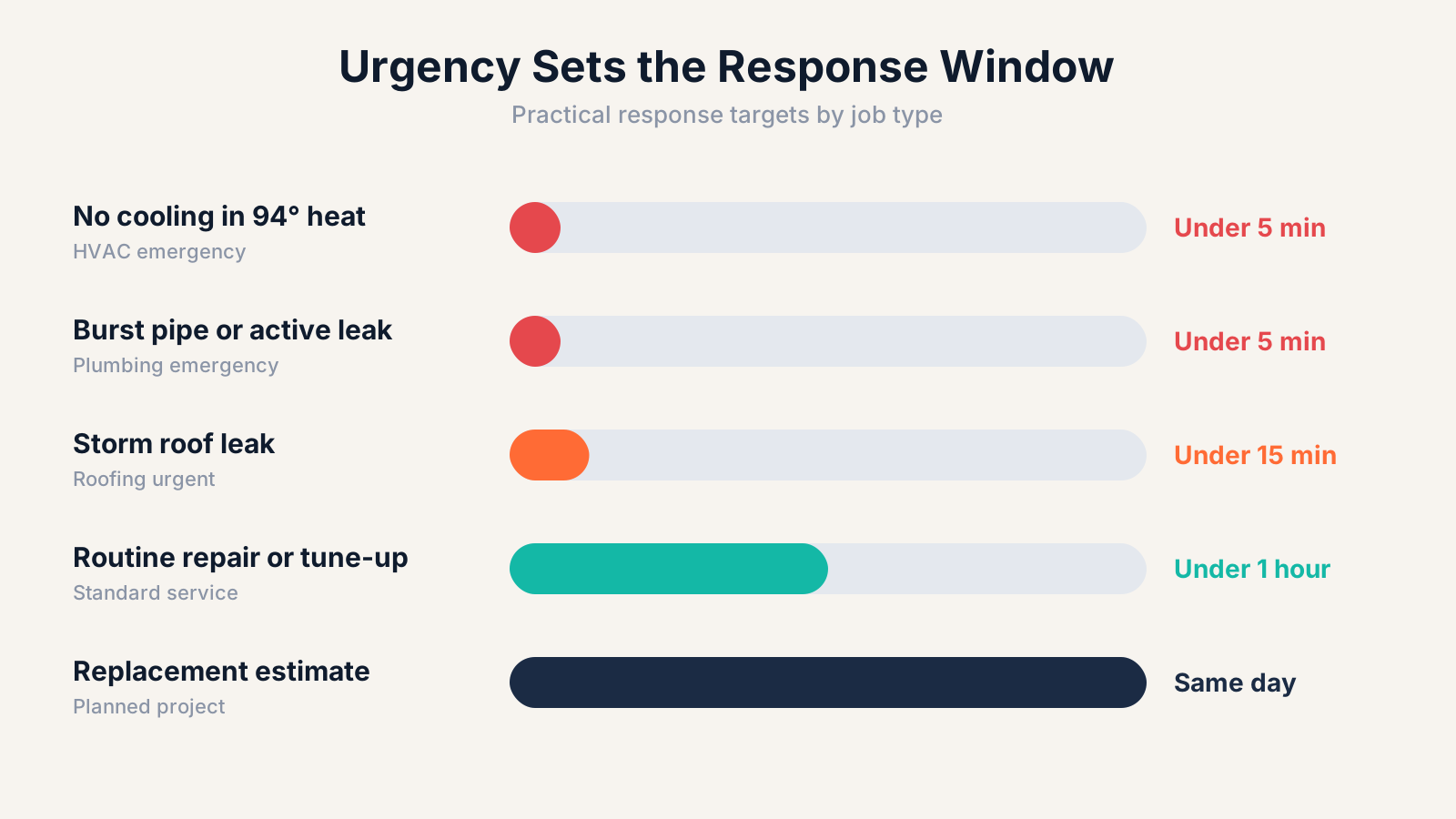
The no-cooling HVAC emergency. With 94 degrees outside and the house heating up, your real window is about five minutes. The homeowner is calling down a list. If you call back in 30 minutes, you'll often hear "We already have someone coming." An emergency lead is the most valuable lead you get, and it's also the one that expires fastest.
The routine plumbing inquiry. Compare that with a homeowner asking for a quote on a water heater replacement next month, or a slow drain in a guest bathroom. The window here might be hours rather than minutes. Speed still wins, though: the first plumber to respond with a clear next step usually sets the price anchor and builds trust before competitors call back.
Lead Type | Homeowner Mindset | Practical Response Target |
|---|---|---|
No cooling in summer heat / no heat in winter | Calling every company until one commits | Under 5 minutes |
Burst pipe, active leak, sewage backup | Panicked, booking the first available | Under 5 minutes |
Storm-related roof leak | Urgent, comparing availability | Under 15 minutes |
Routine repair or tune-up | Comparing a few options | Under 1 hour |
Replacement or remodel estimate | Researching, collecting quotes | Same day, ideally within the hour |
These are practical targets, not hard rules. The point is that urgency compresses the window, and the urgent jobs often carry the highest ticket values and the strongest chance of turning into long-term customers.
Speed to Lead Benchmarks: What the Research Says
The best-known evidence on speed to lead comes from two studies. Neither is specific to home services, since both looked at web-generated leads across industries, but the pattern is consistent and fits what contractors see every day.
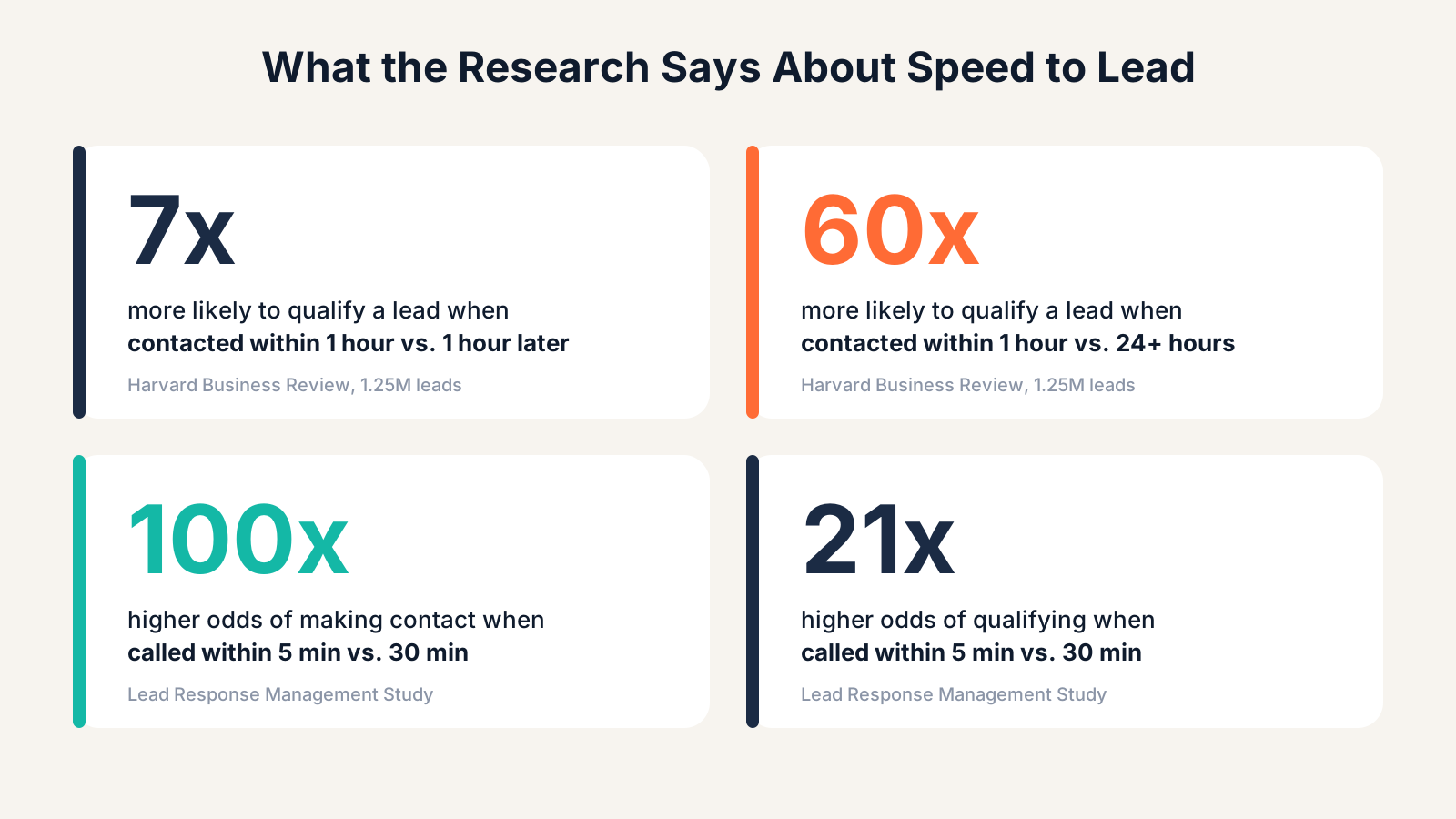
The Harvard Business Review study. In research covering 1.25 million sales leads from 29 B2C and 13 B2B companies in the U.S., firms that tried to reach potential customers within an hour were nearly seven times as likely to qualify the lead as those that waited even an hour longer, and more than 60 times as likely as companies that waited 24 hours or more.
The same researchers also audited how fast companies actually respond. Only 37% responded within an hour and 16% within one to 24 hours. Another 24% took more than 24 hours, and 23% never responded at all. Among companies that did respond within 30 days, the average response time was 42 hours.
The Lead Response Management Study. Conducted by Dr. James Oldroyd with InsideSales.com, it analyzed three years of data from six companies, covering more than 15,000 web-generated leads and over 100,000 call attempts. Calling within five minutes rather than 30 minutes was associated with 100 times higher odds of contact and 21 times higher odds of qualification. Be careful how you repeat this one: it's often misquoted as "21 times more likely to convert," but the study measured contact and qualification, not closed sales.
Home services call data. For contractors, the first problem is often answering at all. Service Direct's 2019 Home Service Call Performance report, covering 42 home service categories, found only 66% of calls were answered on average.
Based on this research, these are reasonable targets for a home service business:
Inbound calls: answered live or by AI on the first ring, every time
Missed calls: text response within 60 seconds
Web forms and lead platforms: first response in under 1 minute, qualified conversation in under 5 minutes
After-hours leads: the same standard as business hours
Why Home Service Teams Miss the Window
Most contractors know speed matters. They miss the window because of structural bottlenecks, not effort.
Missed calls. When your dispatcher is on the line rescheduling a job, the next caller rings out. During a heat wave or cold snap, when call volume spikes, this happens dozens of times a day. Learn how to automate missed call text back so those callers hear from you in seconds.
After-hours gaps. Many homeowners reach out at night, after they get home and find the problem. If your office closes at 5:00, leads from 5:01 onward wait until morning. By then, the 24-hour contractor down the street has booked them. See our guide on how to capture after-hours leads.
Workload and context switching. Your CSRs and dispatchers handle customers, techs, parts, and payments all day. A new web lead sits in an inbox, and it's easy to put off when the phone is ringing and a tech needs an address.
Scattered lead sources. Leads come in from your website, Google Local Services, Angi, Thumbtack, Facebook, and phone. Each one shows up in a different place, so nobody owns all of them.
Inconsistent follow-up. When the first attempt doesn't connect, follow-up depends on someone remembering. Usually nobody does.
None of these are people problems. They're capacity problems, and adding staff only goes so far. A dispatcher can only handle one call at a time.
Building a System That Always Responds First
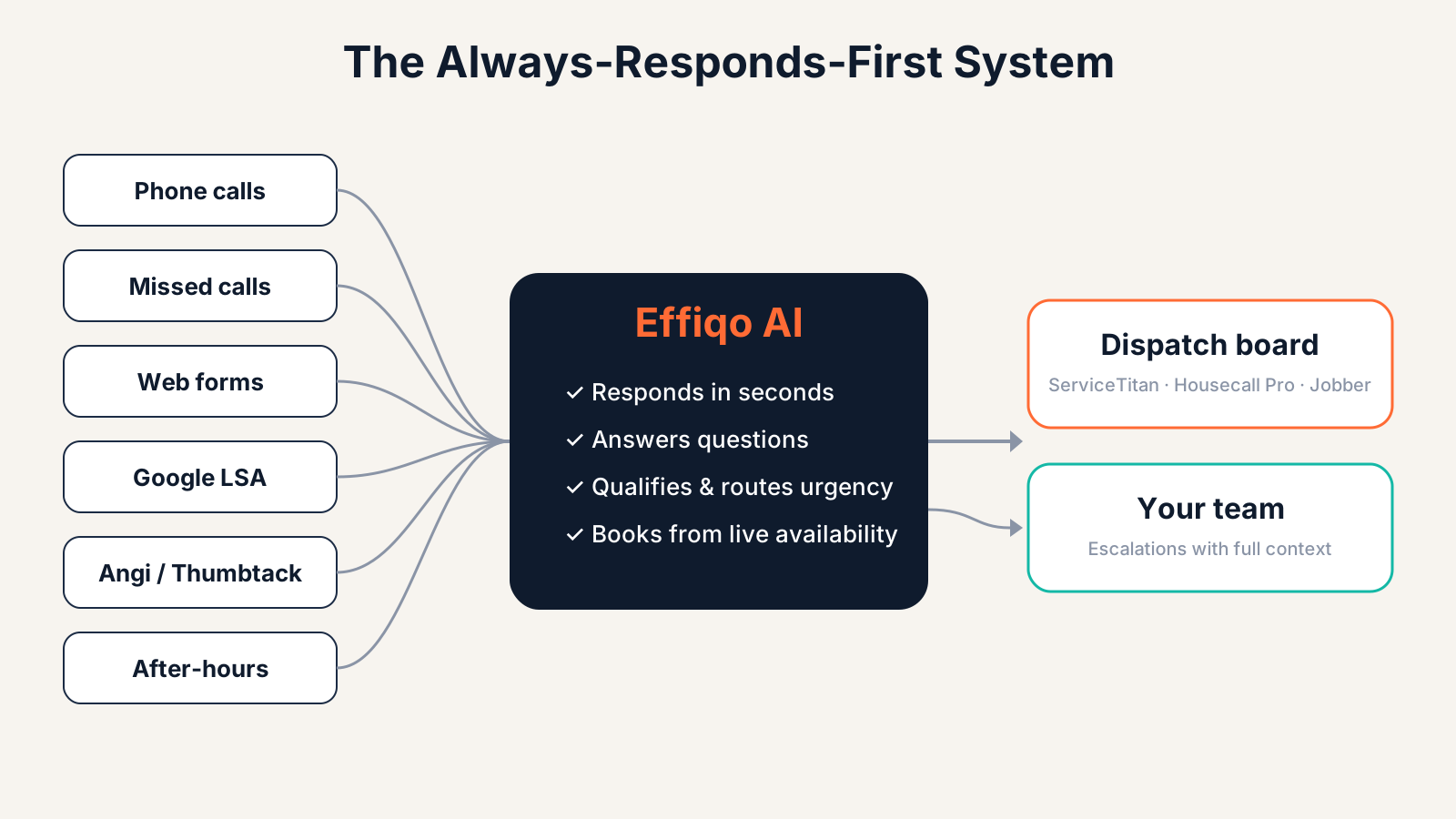
To respond first every time, you need to remove humans as the bottleneck for the first response. People stay in charge of the work. AI and automation handle the instant contact. Here's how to build that.
1. Bring every lead source into one place
Every call, missed call, form fill, and platform lead should flow into a single system. If a lead can arrive somewhere nobody is watching, it eventually will.
2. Let AI make first contact instantly
This is the biggest change. Effiqo's inbound agent, Elise™, responds to every new lead within seconds, whether it's a call, a missed call, or a form, without waiting for a person to notice. It doesn't get tied up on another line. Effiqo can handle many conversations at once, so the tenth caller during a heat wave gets the same instant response as the first.
3. Close the after-hours gap
The system should respond the same way at 9:00 PM on a Saturday as at 10:00 AM on a Tuesday. AI coverage means after-hours leads are engaged and booked right away instead of piling up for the morning shift.
4. Qualify and book in the same conversation
Speed doesn't help much if the customer still has to wait for a callback to schedule. Effiqo qualifies the lead by confirming the problem, urgency, address, and service area, then offers real appointment windows and books the job directly into ServiceTitan, Housecall Pro, or Jobber. The customer goes from first contact to confirmed appointment in one conversation.
5. Route by urgency and set clear escalation rules
Emergencies like no cooling in extreme heat or an active leak should be flagged and prioritized automatically. Define which situations go to a human, such as commercial accounts, complaints, or large replacement opportunities, and make sure the handoff includes full context.
6. Automate persistent follow-up
Leads that don't respond should get a structured follow-up sequence instead of relying on someone's memory. Older leads that went quiet are still worth working too, and the same automation can bring them back into the pipeline.
7. Measure it every week
Track these metrics by lead source and time of day:
Median speed to lead (median is more honest than average)
Percentage of leads contacted within 5 minutes
Contact rate and booking rate
After-hours booking rate compared with business hours
What you measure improves. Review these numbers weekly, and look hardest at evenings, weekends, and peak-season afternoons.
Speed to Lead FAQs
What is speed to lead?
Speed to lead is the time between a customer reaching out and your business making first meaningful contact. For home service contractors, it is one of the clearest predictors of whether a lead becomes a booked job.
What is a good speed to lead for home service businesses?
Aim for a first response in under one minute and a qualifying conversation in under five minutes. Emergencies like no cooling, no heat, or an active leak need an immediate response, while planned estimates can wait a few hours at most.
How do you measure speed to lead?
Subtract the time the inquiry arrived from the time of the first meaningful response. Track the median by lead source and time of day, since averages often hide slow evenings and weekends.
Why is speed to lead so important?
Homeowners contact several contractors at once and book whoever responds first with a clear next step. Research from Harvard Business Review found firms that responded within an hour were nearly seven times as likely to qualify a lead as those that waited an hour longer.
How can AI improve speed to lead?
AI agents respond to every call, missed call, and form within seconds, around the clock, without waiting for a dispatcher to free up. Effiqo also qualifies the lead and books the job directly into ServiceTitan, Housecall Pro, or Jobber.
The Contractor Who Responds First Wins
Speed to lead isn't a vanity metric. For a home service business, it's the earliest point where you either win a job or lose it. The research is clear, and so is what happens in the field: the homeowner with a dead AC in 94-degree heat will book whoever answers first.
You can't hire enough dispatchers to answer every lead instantly, around the clock, through every seasonal rush. What you can do is build a system where every lead gets a response in seconds, gets qualified, and gets booked, with your team stepping in where they add the most value.
See how Effiqo responds to every lead in seconds and books jobs directly onto your dispatch board. Book a Demo


