
AI Answering Service for Contractors: Fix Intake Before Ads - Effiqo
The Ads Are Working. The Leak Is Somewhere Else.
If you've been staring at your ad account wondering why cost-per-lead looks fine but bookings don't, the instinct is to blame the marketing. Wrong targeting. Tired creative. An agency that's lost its edge. So you raise the budget, brief a new campaign, maybe start shopping for a new agency.
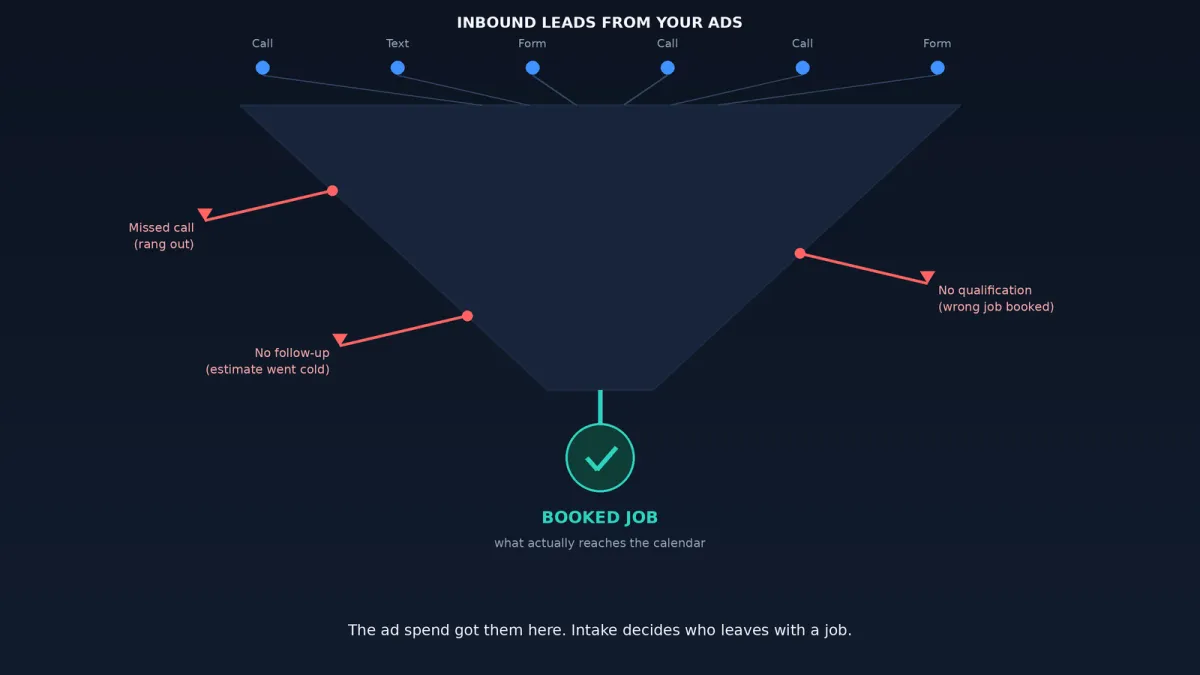
None of that fixes anything, because the marketing was never the problem. The leak is downstream, in the process that happens after someone raises their hand and before they end up on your calendar. That process is intake, and for most home service businesses, it's where the real money disappears. It doesn't matter whether you run HVAC, plumbing, roofing, electrical, or auto repair: a mechanic elbow-deep in an engine or an electrician halfway up a ladder can't grab the phone any faster than a full voicemail box allows.
The Spend-More Trap
Weak return on ad spend has one obvious-looking cause: the marketing. It's the most visible part of the funnel, the part you're paying an agency or a platform for, and the part with a dashboard attached to it. So when the numbers don't add up, spending more or spending differently feels like the fix.
But ads have one job: get the phone to ring, the form to submit, the text to land. If your Google and Meta campaigns are generating calls and inquiries at a reasonable cost, the marketing is doing exactly what you paid for. The problem shows up in what happens in the next sixty seconds, the next hour, the next day, whether that lead actually turns into a booked, paid job.
Pour more spend into a system that's already losing leads after the click, and you're not fixing the leak. You're just running more water through the same hole. Worse, it's often the reason your best leads end up calling the next company on Google instead of you, not because your ad lost to a competitor's ad, but because your phone rang four times and went to voicemail while theirs didn't.
What Intake Actually Is
Intake is everything that happens between "a prospect raised their hand" and "a job is booked and confirmed." It's not one moment, it's a chain, and every link in it can fail independently.
Call, text, or form comes in.
Answer (no answer sends it to the follow-up loop).
Qualify (qualified wrong also sends it to the follow-up loop).
Schedule (a no-show or going quiet also sends it to the follow-up loop).
Booked a job.
The follow-up loop retries from Answer instead of letting the lead disappear.
Most owners can describe their ad funnel in detail (audiences, budgets, creative variants) but couldn't tell you their average ring count before pickup, or how many estimate requests never got a second follow-up. That's the gap. Good intake means every stage above is handled the same way, every time, whether it's a Tuesday morning or 9 p.m. on a Saturday during a heat wave. That's the standard something like Elise™ is built to hold: answering within three rings, qualifying against real job criteria, and booking straight to the calendar without a human bottleneck in the middle.
How to Spot an Intake Problem
You don't need a consultant to diagnose this. A few numbers will tell you almost everything:
Missed-call rate. What percentage of inbound calls never get answered live? Anything meaningfully above zero is lost revenue, not a rounding error.
Speed-to-lead. How long between a form fill or missed call and the first outreach attempt? Response time past the first few minutes is when leads start calling your competitors instead of waiting on you.
Lead-to-booked-job ratio. Not lead-to-estimate: lead to an actual job on the schedule. If your ad platform says you're generating plenty of leads but this ratio is thin, the leak is in the middle, not the top.
Hold time and abandonment. During your busiest hour, how long does a caller actually wait? Time it yourself.
The no-answer follow-up process. When someone doesn't pick up your callback, or requests an estimate and doesn't respond, what actually happens next? For most businesses, the honest answer is "nothing systematic."
If you can't answer these with real numbers, that's the diagnosis on its own. You're measuring the top of the funnel closely and the middle not at all.
Why More Leads Make It Worse
Here's the part that makes the "spend more" instinct actively dangerous: when you double your ad spend, you just drop twice as many leads. If your intake process is losing 30% of qualified leads before they book, that 30% doesn't shrink just because you're sending more traffic through it. It just means more leads falling through the same hole.
Double your ad budget with a 30% leak, and you don't just get double the bookings. You get double the leads falling through, double the wasted dollars, and a reception team or answering process now buckling under call volume it was never built to handle. Response times slip further. Qualification gets sloppier under pressure. The leak widens at the exact moment you're paying the most to fill the top of the funnel.
This is also usually the moment an agency relationship sours, not because the campaigns stopped working, but because the business owner is looking at rising spend and flat bookings and concluding the marketing failed. Often it's the opposite: the marketing worked well enough to expose a structural problem that was always there, just previously hidden by lower volume.
Fixing Intake First
Before the next round of ad spend or the next agency conversation, the higher-leverage move is auditing and fixing intake:
Answer every inbound touchpoint fast, all the time, not just during business hours. This is what an AI answering service for contractors actually does, whether that means after-hours answering for HVAC, plumbing, roofing, electrical, or auto repair. Elise™ handles it with three-ring answers, real qualification against job criteria, and direct booking to the calendar, 24/7.
Qualify consistently, not based on who happens to pick up. A rushed team member and a calm one shouldn't produce different outcomes for the same caller.
Book directly to the calendar instead of "we'll follow up" : every extra touch between qualification and a confirmed appointment is another chance for the lead to go cold or call someone else.
Systematically reactivate the leads that didn't convert the first time: unanswered calls, unclosed estimates, past customers who are due for service. This is where Xavier™ does the outbound side of the same job, working dormant contacts on a schedule instead of leaving them to fall out of the pipeline entirely.
The proof isn't theoretical:
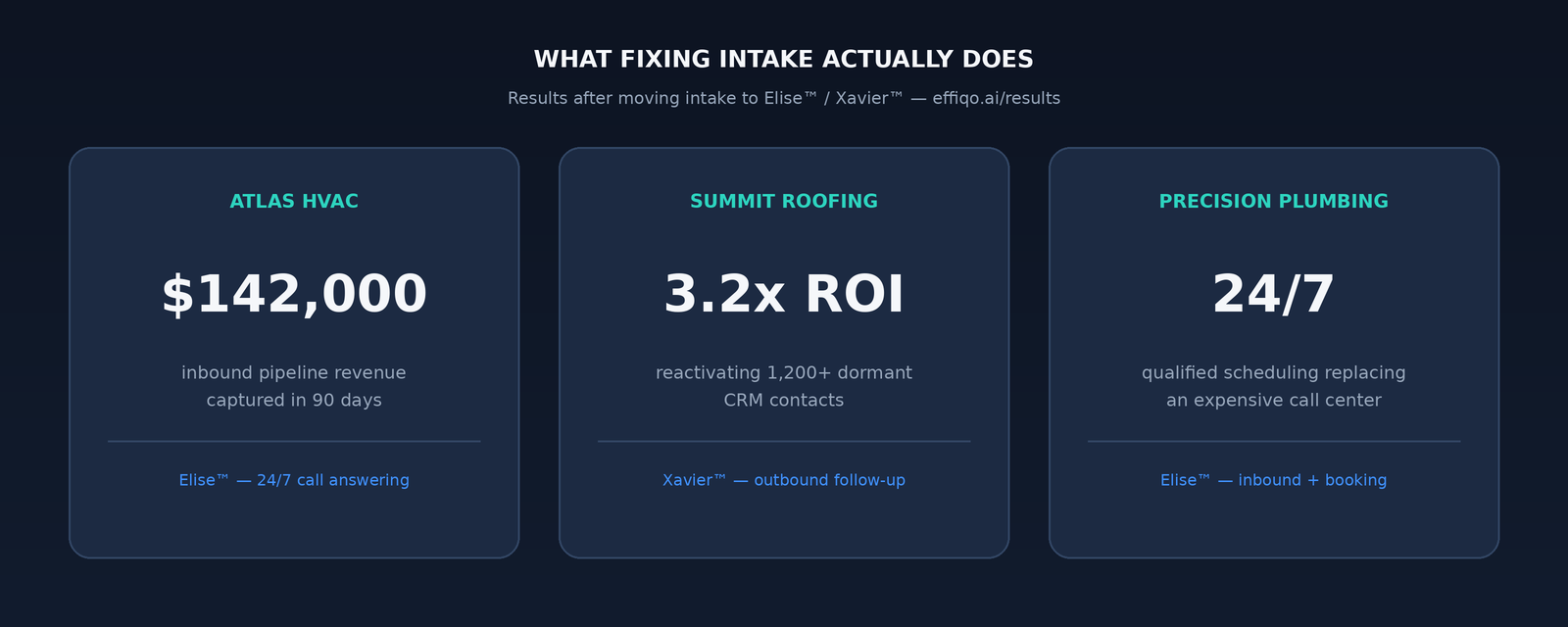
None of those wins came from a new campaign. They came from closing the gap between the lead and the job. See the full case studies or how the full infrastructure fits together end to end.
Fix the Leak Before You Turn Up the Tap
More ad spend on a leaking intake process is just a more expensive way to lose the same leads. Before you brief another campaign or take another agency call, get honest numbers on your missed-call rate, your speed-to-lead, and your booked-job ratio. That's where the real return is sitting.
Curious what this looks like on a real call? Talk to our AI and hear how intake is supposed to work. If you'd rather walk through it for your specific business, you can also book a demo.


